
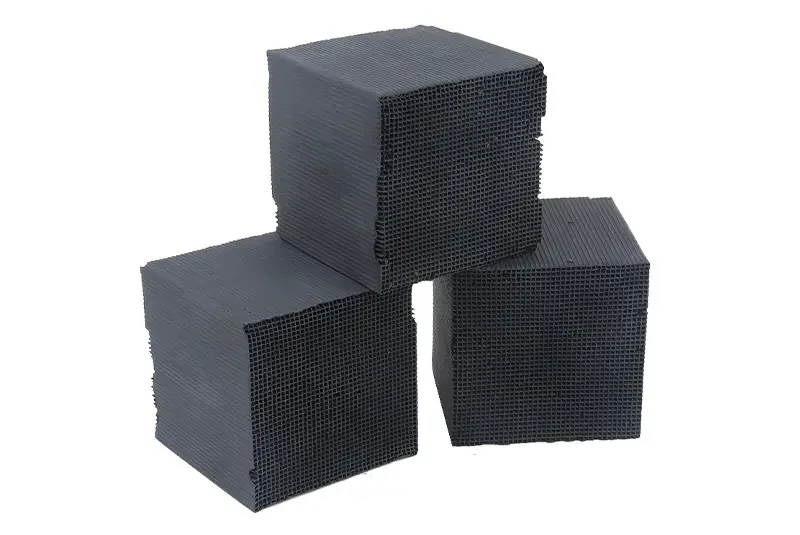
Industrial air purification and volatile organic compound (VOC) emission control have become central priorities for manufacturers worldwide. From automotive painting lines and chemical processing plants to semiconductor cleanrooms and pharmaceutical facilities, companies face mounting pressure to meet stringent environmental regulations while keeping operational costs manageable. The European Union’s VOC Directive, China’s GB37822-2019 standard, and similar U.S. EPA regulations have accelerated the demand for more efficient, energy-conscious air treatment technologies. In this evolving landscape, honeycomb activated carbon has emerged as a specialized adsorbent material that addresses the dual challenges of high adsorption efficiency and low system pressure drop. Its unique structural design sets it apart from traditional granular and powdered forms, making it particularly well-suited for large-volume gas-phase filtration applications.
Honeycomb activated carbon is a structured activated carbon adsorbent manufactured by molding high-quality activated carbon powder with specialized binders into blocks with uniform, parallel honeycomb-shaped channels. It delivers high adsorption capacity for VOCs, odors, and harmful gases while maintaining significantly lower airflow resistance compared to loosely packed granular carbon beds, making it the preferred choice for industrial exhaust treatment, air purification systems, and solvent recovery applications.
Understanding the full scope of honeycomb activated carbon requires examining its structural principles, manufacturing techniques, raw material choices, performance specifications, and real-world applications. The material represents a shift from loose adsorbent media toward engineered, structured filtration solutions that integrate more seamlessly into modern modular air handling systems. The following sections provide a comprehensive technical overview designed for engineers, procurement professionals, and environmental managers evaluating honeycomb activated carbon for their gas-phase treatment needs.
Table of Contents
- What Is Honeycomb Activated Carbon
- How Is Honeycomb Activated Carbon Manufactured
- Key Types and Technical Specifications of Honeycomb Activated Carbon
- Primary Industrial Applications and Use Cases
- Advantages of Honeycomb Activated Carbon Compared to Other Forms
- Market Trends and Future Outlook for Honeycomb Activated Carbon
What Is Honeycomb Activated Carbon
Honeycomb activated carbon is an engineered adsorbent material consisting of activated carbon powder pressed and activated into rigid blocks with a regular honeycomb or cubic channel structure. The parallel through-channels create an exceptionally large gas-solid contact surface area while allowing air to flow with minimal resistance, making it fundamentally different from granular, powdered, or extruded pellet forms of activated carbon.
The core functional principle of honeycomb activated carbon lies in its geometric design. Unlike granular activated carbon (GAC), where gas passes through irregularly packed particles with varying interstitial spaces, honeycomb blocks feature straight, uniform channels that guide airflow evenly across the entire cross-section of the media. This structured flow path eliminates the channeling, dead zones, and localized pressure buildup that commonly occur in packed beds. Each channel wall is composed of highly porous activated carbon with a developed microporous structure. The internal pore network, with surface areas typically ranging from 400 to 1500 m²/g depending on the raw material and activation process, provides abundant adsorption sites where VOC molecules, odor compounds, and other gaseous pollutants are captured through van der Waals forces and physical adsorption.
The structural characteristics directly translate into measurable performance advantages. In gas-phase filtration systems, the pressure drop across honeycomb activated carbon blocks is typically 5 to 11 times lower than that across equivalent granular carbon beds at the same linear gas velocity, based on field measurement data from industrial exhaust treatment projects. This reduced resistance means the system’s exhaust fan consumes less energy to maintain the required airflow rate. The blocks are manufactured in standardized dimensions, most commonly 100 x 100 x 100 mm and 100 x 100 x 50 mm, though custom sizes are widely available for original equipment manufacturer (OEM) integration. The regular block geometry also facilitates modular installation in filter housings, adsorption boxes, and air handling units, simplifying both initial setup and ongoing replacement cycles.
How Is Honeycomb Activated Carbon Manufactured
The manufacturing of honeycomb activated carbon follows a multi-stage process: high-quality activated carbon powder is mixed with an environmentally friendly binder, extruded or pressed into a honeycomb green body, dried, and then subjected to high-temperature carbonization and activation to develop the final pore structure and mechanical strength. The choice of raw material, binder type, and activation conditions all significantly influence the finished product’s adsorption capacity, structural integrity, and water resistance. For a detailed overview of the preparation process, see this guide on honeycomb activated carbon preparation methods.
Raw material selection is the first critical stage. Manufacturers use three primary categories of activated carbon powder as feedstock: coal-based, coconut shell-based, and wood-based. Coal-based powder, typically derived from high-quality bituminous coal, offers high mechanical strength, stable performance, and cost-effectiveness, making it the most common choice for general industrial waste gas treatment. Coconut shell-based powder delivers superior adsorption performance with iodine values exceeding 1000 mg/g, lower ash content (below 5%), and a finer pore structure, which suits high-end air purification and precious gas recovery applications. Wood-based powder provides moderate adsorption capacity with good biodegradability, appropriate for low-concentration waste gas purification scenarios.
Once the base powder is selected, it is uniformly mixed with a binder such as phenolic resin, polyacrylonitrile, or other specialized adhesives. The binder serves two essential functions: it enables the powder mixture to maintain structural integrity after molding, and it contributes additional carbon content during subsequent thermal processing. The resulting paste is extruded or pressed through dies to form the characteristic honeycomb geometry with straight parallel channels. The green body then undergoes controlled drying at temperatures of approximately 120 to 150 degrees Celsius to remove moisture. The dried blocks advance to carbonization, which occurs at 600 to 800 degrees Celsius in an oxygen-limited environment. This step thermally decomposes the binder and initial volatile components, creating a preliminary carbon skeleton. The final activation stage takes place at 900 to 1100 degrees Celsius using physical activation agents such as steam or carbon dioxide, which react with the carbon matrix to develop the extensive microporous and mesoporous network responsible for adsorption performance. Some manufacturers apply additional hydrophobic treatment to produce water-resistant grades, which are dried in kilns at high temperatures for several hours longer than standard products.
Key Types and Technical Specifications of Honeycomb Activated Carbon
Honeycomb activated carbon is classified primarily by raw material type (coal-based, coconut shell-based, wood-based) and water resistance (standard and water-resistant grades). Key technical parameters include specific surface area, iodine adsorption value, CTC value, ash content, compressive strength, and pore channel dimensions, all of which should be matched to the target application’s VOC profile, humidity conditions, and airflow requirements.
The following table provides a comparative overview of the three main raw material types and their typical performance characteristics:
| Parameter | Coal-Based | Coconut Shell-Based | Wood-Based |
| Specific Surface Area (m²/g) | 800–1200 | 1000–1500 | 700–1000 |
| Iodine Value (mg/g) | ≥800 | ≥1000 | ≥700 |
| CTC Value (%) | 60–70 | 65–80 | 50–65 |
| Ash Content (%) | ≤15 | ≤5 | ≤10 |
| Compressive Strength (MPa) | ≥1.5 | ≥2.0 | ≥1.2 |
| Typical Pore Size (mm) | 1–5 | 0.5–3 | 1–4 |
The CTC (Carbon Tetrachloride Activity) value is one of the most critical performance indicators for VOC adsorption applications. It measures the weight percentage of carbon tetrachloride vapor that a given mass of activated carbon can adsorb under standardized conditions. A higher CTC value correlates directly with greater micropore volume and enhanced adsorption capacity for many common industrial VOCs, including toluene, xylene, benzene, alcohols, and ketones. For general odor control and low-VOC-loading scenarios, materials with CTC values in the 50 to 60 percent range are typically adequate. Standard industrial VOC treatment applications usually call for CTC 60 to 70 percent products, while demanding conditions such as solvent recovery systems, high-concentration chemical plant exhaust, or facilities operating under strict emission limits benefit from CTC values at or above 70 percent.
Water resistance is another key classification dimension. Standard honeycomb activated carbon blocks are air-dried and suitable for dry gas streams with humidity below 20 percent. When exposed to high-humidity exhaust or systems equipped with water spray safety devices, standard blocks may gradually soften, chalk, or lose structural integrity. Water-resistant grades undergo additional high-temperature kiln drying that imparts hydrophobic properties, enabling stable long-term operation in moisture-rich environments such as paint spray booths, wastewater treatment plant exhaust, and wet scrubbing system downstream applications. The trade-off is a higher unit cost and longer production lead time, typically requiring 5 to 7 additional days of manufacturing.
Primary Industrial Applications and Use Cases
Honeycomb activated carbon is predominantly deployed in gas-phase purification applications spanning industrial exhaust treatment, VOC abatement, air purification in commercial and institutional buildings, odor control, solvent recovery, and specialized environmental protection scenarios where large air volumes and low-to-medium pollutant concentrations must be processed efficiently.
Industrial exhaust treatment represents the largest application domain. Chemical plants, petrochemical facilities, and pharmaceutical manufacturing sites use honeycomb activated carbon to remove VOCs, hydrogen sulfide, sulfur dioxide, and other hazardous air pollutants from process vents, storage tank emissions, and reactor exhaust streams. The coating and painting sectors, including automotive painting lines, furniture finishing operations, and metal coating facilities, rely on honeycomb blocks to capture aromatic hydrocarbons, alcohols, esters, and ketones released during spray application and curing. Printing and electronics manufacturing facilities employ the material for solvent vapor control and cleanroom ventilation purification.
Air purification in built environments constitutes another significant application category. Central air conditioning systems in commercial buildings, hospitals, hotels, airports, and large public venues incorporate honeycomb activated carbon filters to remove indoor VOCs, formaldehyde, odors, and airborne particulates. The material’s low pressure drop characteristic is particularly advantageous in HVAC applications, where fan energy consumption represents a substantial portion of building operating costs. Coconut shell-based honeycomb activated carbon, with its high purity and minimal ash content, is commonly specified for premium indoor air quality projects where secondary pollution from the filter media itself must be avoided.
Odor control applications span a wide range of facilities, including wastewater treatment plants, landfill gas management systems, food processing factories, and waste transfer stations. In these settings, honeycomb activated carbon adsorbs hydrogen sulfide, ammonia, mercaptans, and other odoriferous compounds produced by biological decomposition processes. Solvent recovery systems in printing, dry cleaning, and chemical processing industries use honeycomb blocks to capture valuable solvents from exhaust air, which can then be recovered through thermal or steam regeneration, offsetting operational costs while ensuring regulatory compliance.
Additional specialized applications include flue gas desulfurization and denitrification, biogas and natural gas purification for clean energy production, precious metal recovery, pressure swing adsorption for gas separation, and aquarium water purification where water-resistant grades provide both mechanical filtration and dissolved organic compound removal.
Advantages of Honeycomb Activated Carbon Compared to Other Forms
Honeycomb activated carbon offers four distinct advantages over traditional granular and powdered activated carbon forms: significantly lower system pressure drop, higher packing density with a more compact footprint, easier modular replacement and maintenance, and more uniform flow distribution that minimizes dead zones and channeling. However, it is not a universal replacement for all carbon forms and is primarily suited to gas-phase rather than liquid-phase applications.
The comparison between honeycomb and granular activated carbon highlights the structured media advantage most clearly. According to industry analysis on the shift from granular to honeycomb carbon, granular carbon beds require careful packing, fixing, and anti-leakage measures. Airflow passes randomly through irregular particle gaps, creating zones of higher and lower velocity that lead to uneven utilization of the adsorption capacity. In contrast, honeycomb blocks direct flow through engineered straight channels, achieving near-uniform velocity distribution across the entire media face. The following table summarizes key performance and operational differences:
| Comparison Item | Granular Activated Carbon | Honeycomb Activated Carbon |
| Media Form | Loose granular particles | Structured honeycomb block |
| Airflow Path | Through packed particle bed | Through straight uniform channels |
| Pressure Drop | Higher, dependent on bed depth | Lower, 5–11× reduction vs. equivalent GAC |
| Installation | Requires packing, fixing, anti-leakage | Modular, plug-in block replacement |
| Maintenance | Media removal and repacking needed | Block-by-block module swap |
| Dust Generation | Moderate to high | Low |
| Regeneration | Thermal regeneration feasible | Thermal regeneration feasible with proper design |
| Primary Application | Deep-bed adsorption towers, water treatment | VOC filters, air handling units, modular systems |
From an operational cost perspective, the lower pressure drop of honeycomb activated carbon directly reduces fan energy consumption. In large-air-volume systems processing tens of thousands of cubic meters per hour, even a modest decrease in static pressure can translate into significant annual electricity savings. The compact modular design also reduces the physical footprint of treatment equipment, which is valuable in retrofit projects where space constraints limit system expansion options.
It is important to recognize that powdered activated carbon (PAC) serves a fundamentally different role: it is primarily used in liquid-phase emergency treatment and rapid decontamination scenarios due to its extremely fast adsorption kinetics but is non-regenerable and single-use. Honeycomb activated carbon occupies a distinct niche in continuous, gas-phase, low-to-medium concentration applications where structured geometry, long service life, and system integration advantages outweigh the higher per-unit material cost.
Market Trends and Future Outlook for Honeycomb Activated Carbon
The global activated carbon market is on a strong growth trajectory, projected to expand from approximately USD 5.90 billion in 2026 to around USD 11.47 billion by 2033, driven by tightening environmental regulations on VOC emissions, rising demand for energy-efficient air pollution control technologies, and increasing adoption of structured carbon media in industrial exhaust treatment systems across Europe, Asia-Pacific, and North America.
Regulatory pressure remains the single most powerful market driver. The European Union’s Industrial Emissions Directive, China’s ongoing implementation of GB37822-2019 for fugitive VOC emissions, and the U.S. EPA’s National Emission Standards for Hazardous Air Pollutants (NESHAP) continue to compel manufacturers in the coatings, chemicals, electronics, and pharmaceutical sectors to upgrade from basic filtration to high-performance adsorption systems. Honeycomb activated carbon, with its proven combination of low pressure drop and high adsorption efficiency, has become a go-to material for compliance-driven system upgrades. The Asia-Pacific region, accounting for the largest share of global activated carbon consumption due to its concentration of manufacturing activity, is expected to maintain the fastest growth rate as environmental enforcement intensifies.
Several emerging trends are shaping the future of the honeycomb activated carbon market. The shift from loose adsorbent media to structured, engineered media is accelerating as equipment manufacturers design increasingly compact and modular air purification systems. The development of chemically impregnated and catalytically functionalized honeycomb carbons is expanding the material’s capabilities beyond physical adsorption to include targeted chemisorption of specific pollutants such as mercury vapor, acid gases, and ammonia. Sustainability considerations are also influencing procurement decisions: honeycomb blocks generate less dust during handling compared to granular media, and their longer service intervals reduce replacement frequency and associated waste generation. As industries worldwide pursue carbon neutrality goals, the energy-saving characteristics of low-pressure-drop honeycomb systems align with broader corporate sustainability objectives, positioning the technology for continued adoption across both mature and emerging industrial markets.
This article provides a general technical overview of honeycomb activated carbon for industrial gas-phase applications. Selection of specific products and system designs should be based on detailed analysis of target pollutant profiles, operating conditions, and local regulatory requirements.