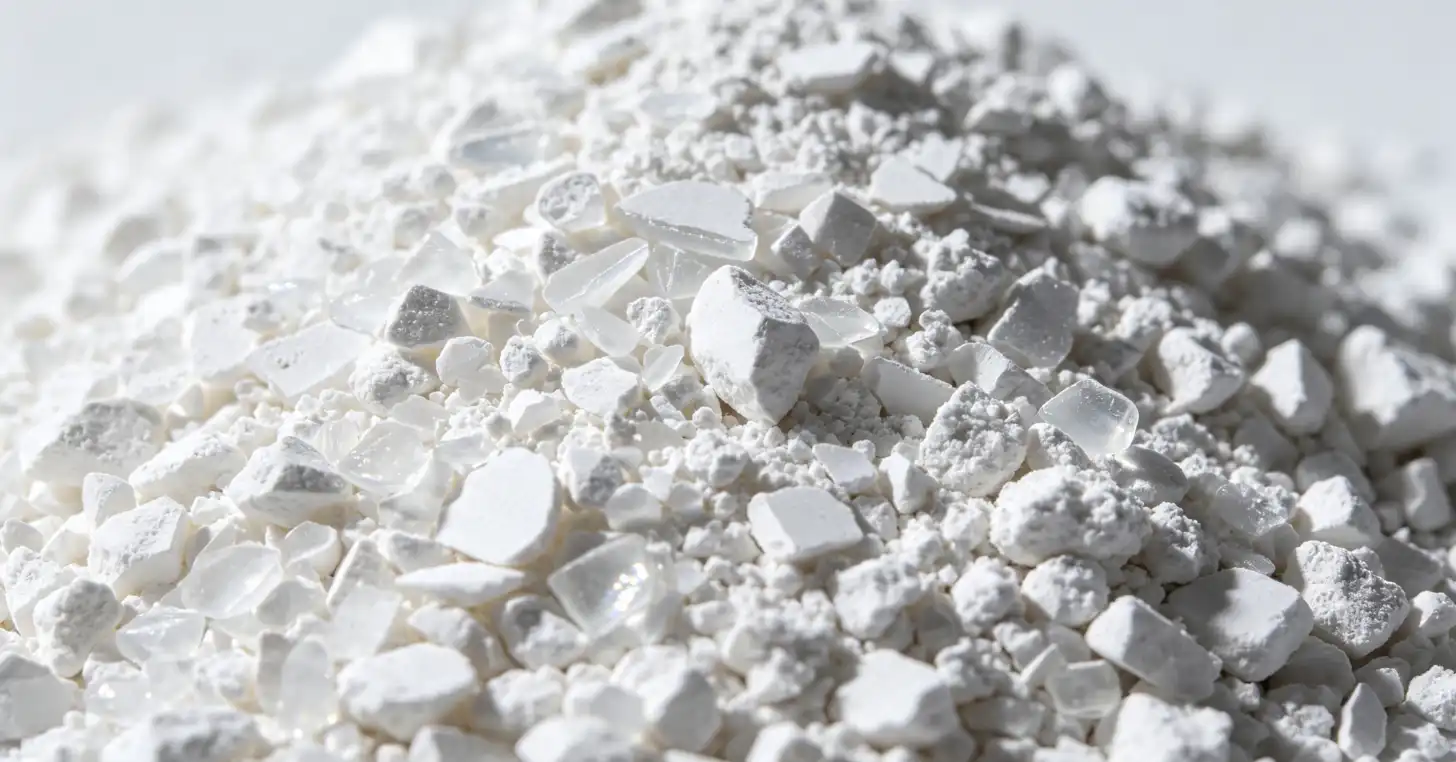
Mechanical ball milling Alumina
- Home /
- Alumina /
- Types of Alumina /
- Mechanical Ball Milling Alumina
Produced through high-energy mechanical ball milling, this alumina delivers finely controlled particle size reduction, enhanced surface activity, and improved reactivity. Its cost-effective, scalable process produces consistent fine and ultrafine powders ideal for advanced ceramics, refractory materials, composite manufacturing, and precision surface finishing applications.

What Is Mechanical ball milling Alumina?
Mechanical Ball Milling Alumina refers to aluminum oxide (Al₂O₃) that has been processed through high-energy ball milling — a solid-state size reduction technique in which alumina feed material is loaded into a rotating or vibrating mill chamber along with grinding media, typically hardened steel, zirconia, or alumina balls. The repeated impact, compression, and shear forces generated between the milling media and alumina particles progressively fracture and refine the material into fine or ultrafine powders with enhanced surface characteristics.
Unlike chemical synthesis routes that build alumina from molecular precursors, ball milling is a top-down physical process — starting from coarser alumina feedstock and breaking it down to the desired particle size range. Milling parameters including rotational speed, media size, milling duration, and atmosphere can be systematically adjusted to target specific particle size distributions, surface areas, and degrees of structural defect introduction.
At extended milling times and high energy inputs, mechanical ball milling can also induce partial amorphization of the alumina crystal structure, increase lattice strain, and generate highly reactive surface states — properties that can be exploited in sintering, catalytic, and composite material applications. This combination of size reduction and surface activation makes Mechanical Ball Milling Alumina a practical and versatile material solution across a broad range of industrial sectors.
Why Choose Mechanical Ball Milling Alumina?
-
Precise Particle Size Reduction : Milling parameters can be tuned to achieve target particle size distributions — from fine grinding to ultrafine and nanoscale ranges — delivering the specific powder fineness required for downstream ceramic, composite, or coating processes.
- Enhanced Surface Activity: High-energy milling introduces surface defects, increases surface area, and generates reactive surface states that improve sintering behavior, bonding performance, and chemical reactivity in catalyst and composite applications.
-
Cost-Effective & Scalable Processing: Ball milling utilizes established, industrially proven equipment with low operational complexity, enabling reliable large-scale alumina powder production at competitive processing costs without expensive chemical reagents or controlled reaction environments.
-
Broad Feedstock Compatibility:Mechanical ball milling can process a wide range of alumina feedstocks — including calcined, fused, and sintered alumina — converting various starting grades into fine powders suited for specific application requirements.
-
Improved Sintering Performance: Reduced particle size and increased surface energy from milling lower sintering temperatures and shorten densification times, improving ceramic processing efficiency and enabling tighter control over final microstructure and mechanical properties.
-
Dry & Wet Milling Flexibility:Both dry and wet milling configurations are supported, allowing process optimization for different end-use requirements — whether maximizing powder flowability for dry pressing or achieving superior dispersion for slurry-based ceramic and coating applications.
Industry Challenges
Particle Size Consistency
Contamination Control
Thermal Sensitivity
Surface Area Degradation
Agglomeration Tendency
Scalability Limitations
Product overview
Alumina
AP-α-ELE/P300
Why Use Our Mechanical ball milling Alumina
High Purity Retention
Advanced milling processes minimize cross-contamination, preserving the chemical integrity of alumina and meeting strict purity requirements for technical and industrial-grade applications.
Enhanced Surface Area
The milling process effectively increases BET surface area, improving reactivity and adsorption capacity — critical for catalytic, refractory, and functional material applications.
Superior Particle Uniformity
Mechanical ball milling produces a narrow particle size distribution, reducing variability between batches and delivering consistent quality that downstream processes can depend on.
Related Applications

Industry Solutions
Packaging & Logistics Services
Secure & Customizable Packaging
The products shall be enclosed in a durable, moistureproof pouch or bulk container, so as to guarantee the cleanliness and completeness of transportation. Customized packing options for special size and handling needs.
Reliable & Flexible Global Shipping
Working with reliable logistic partners, we provide a flexible delivery system for maritime, aerial and land-based cargo. Prompt delivery and safe transport to worldwide destinations.
Dedicated Order & Support Coordination
We offer special support for tracking and documenting from the order validation to the last shipment. Availability of technical and logistical support to guarantee the success of the supply chain experience.
Ready to Find Your Perfect Industrial Solution?
How to Order!
Send us your detailed question, or ask for a quote tailored to your activated carbon requirements.