
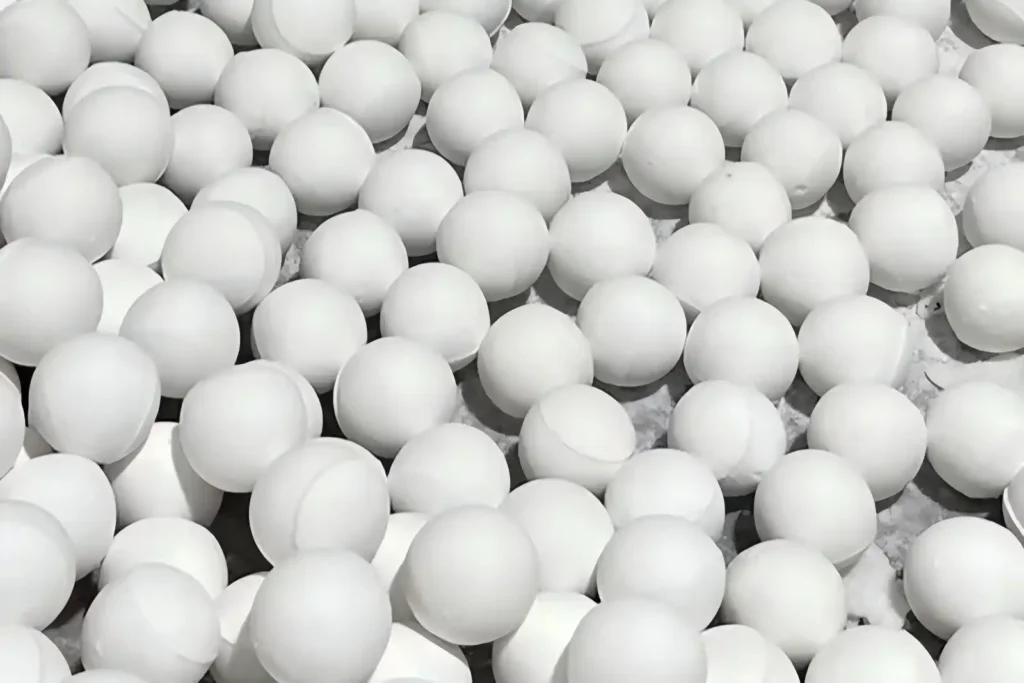
Industrial grinding and catalytic processing demand materials that can endure extreme mechanical stress, high temperatures, and corrosive chemical environments without contaminating the end product. Across sectors ranging from ceramic manufacturing and mining to petrochemical refining and advanced battery production, engineers and procurement professionals continually seek media that combine longevity, efficiency, and purity. Alumina spheres, also known as alumina ceramic balls, have emerged as one of the most versatile solutions for these demanding applications. Composed primarily of aluminum oxide (Al2O3), these precision-engineered spheres deliver a unique combination of hardness, density, and chemical inertness that traditional steel or glass media simply cannot match.
Alumina spheres are high-purity aluminum oxide ceramic balls with a Mohs hardness of approximately 9, a density of 3.6 to 3.9 g/cm³, and exceptional chemical stability, making them the preferred choice for grinding media in ball mills, catalyst bed support in petrochemical reactors, and fine powder processing across more than a dozen industries.
The breadth of applications for alumina spheres reflects their adaptability to different performance requirements. Available in alumina content grades from 75% to 99%, with diameters ranging from 0.5 mm to 120 mm, these ceramic balls can be tailored to specific milling intensity, purity, and cost targets. The global market for alumina ceramic balls was valued at approximately USD 1.80 billion in 2025 and is projected to reach USD 3.50 billion by 2034, growing at a compound annual growth rate of 7.69%. This sustained expansion underscores the material’s growing role in industrial processing worldwide.
Table of Contents
- What Are Alumina Spheres and How Are They Manufactured?
- What Are the Key Physical and Chemical Properties of Alumina Ceramic Balls?
- What Are the Primary Industrial Applications of Alumina Spheres?
- How to Select the Right Alumina Sphere Grade for Your Application
- What Is the Market Outlook for Alumina Ceramic Balls?
What Are Alumina Spheres and How Are They Manufactured?
Alumina spheres are spherical grinding and support media manufactured from high-purity aluminum oxide powder through forming and high-temperature sintering, producing ceramic balls with a dense α-Al2O3 crystal structure that delivers extreme hardness, wear resistance, and thermal stability.
The production of alumina spheres begins with the careful selection of raw materials. High-purity industrial alumina powder serves as the primary ingredient, supplemented by minor quantities of silica, rare earth metal oxides, and sintering aids that influence the final microstructure and performance characteristics. The raw powder undergoes rigorous particle size refinement to ensure uniform consistency before forming. The forming stage determines the sphere’s initial shape and density and follows one of two principal routes depending on the target alumina grade.
Isostatic pressing is the preferred method for high-purity grades, typically those containing 95% to 99% alumina. In this process, the powder is loaded into a flexible mold and subjected to uniform high pressure from all directions, resulting in a green body with exceptionally consistent density and minimal internal defects. The compacted spheres are then sintered at temperatures exceeding 1600°C, during which the powder particles fuse through solid-state diffusion, transforming into the stable α-Al2O3 corundum phase. This high-temperature treatment yields a product with near-zero porosity, maximum hardness, and outstanding mechanical strength.
For mid-range grades such as 92% alumina, a rolling or shaping process is more commonly employed. The powder is mixed with organic binders and fed into a rotating granulator or ball-forming machine, where it gradually builds into spherical shapes through a tumbling action analogous to forming confectionery. The shaped spheres are dried and then sintered at similarly high temperatures. While this method is more cost-effective, it typically produces slightly lower density and more residual porosity compared to isostatically pressed equivalents. Regardless of the forming route, all alumina spheres undergo strict quality control checks including density measurement, hardness testing, wear rate evaluation, and chemical composition verification against standards such as ASTM C1327 and ISO 14703.
The controlled sintering process is central to achieving the desired crystal structure. At temperatures above 1400°C, the transition alumina phases convert irreversibly to α-Al2O3, the thermodynamically stable form characterized by a hexagonal close-packed oxygen lattice with aluminum ions occupying two-thirds of the octahedral interstices. This crystal structure is responsible for the material’s renowned hardness and chemical stability. The final grain size typically ranges from 2 to 8 micrometers for standard grades and 1 to 3 micrometers for high-purity variants, with finer grains generally correlating with higher mechanical strength and lower wear rates.
What Are the Key Physical and Chemical Properties of Alumina Ceramic Balls?
Alumina spheres possess a Mohs hardness of 8 to 9.2, a specific gravity of 3.27 to 3.90, compressive strength exceeding 2000 MPa for high-purity grades, water absorption below 0.02%, and near-total chemical inertness against acids and alkalis, with maximum service temperatures reaching 1700°C depending on alumina content.
The physical properties of alumina spheres vary systematically with their alumina content, and the table below summarizes key parameters across the commercially relevant grade spectrum. These values are compiled from manufacturer technical specifications and industry reference data covering the full range from 75% to 99% alumina content.
| Property | 75% Al2O3 | 85% Al2O3 | 90% Al2O3 | 92% Al2O3 | 95% Al2O3 | 99% Al2O3 |
| Mohs Hardness | 8 | 8 | 9 | 9 | 9 | 9.2 |
| Specific Gravity (g/cm³) | 3.27 | 3.50 | 3.55 | 3.60 | 3.65 | 3.70+ |
| Water Absorption (%) | 0.02 | 0.02 | 0.02 | 0.01 | 0.01 | 0.01 |
| Fe2O3 Content (%) | 0.5 | 0.2 | 0.01 | 0.01 | 0.01 | 0.01 |
| Wear Rate (%) | 0.20 | 0.20 | 0.20 | 0.15 | 0.10 | 0.10 |
| Compressive Strength (MPa) | 90+ | 120+ | 150+ | 2000+ | 2250+ | 180+* |
Hardness is the most immediately consequential property for grinding applications. With a Mohs hardness approaching that of corundum and surpassed only by diamond, cubic boron nitride, and silicon carbide, alumina spheres can effectively abrade the vast majority of industrial minerals and ceramic raw materials. The high specific gravity, ranging from 3.27 to over 3.90 g/cm³, provides sufficient mass to generate impactful kinetic energy within a rotating mill, ensuring efficient particle size reduction. Although lower in density than steel balls at approximately 7.8 g/cm³, alumina spheres compensate through superior hardness and dramatically reduced contamination.
The low wear rate is a defining economic advantage. High-grade alumina spheres exhibit wear losses as low as 0.10%, meaning that for every ton of material processed, only a minute fraction of the grinding media is consumed. This extends media replacement intervals, reduces machine downtime, and critically limits the introduction of foreign particles into the product stream. The near-zero water absorption and low apparent porosity of isostatically pressed grades further contribute to structural integrity under wet grinding conditions, preventing media degradation from liquid infiltration.
On the chemical side, alumina spheres are essentially inert in most industrial environments. With acid resistance exceeding 98.5% and alkali resistance above 95% for high-purity grades, they do not react with or dissolve into the materials they process. This is particularly critical in electronic material and battery powder manufacturing, where even trace iron contamination from steel media can render entire batches unusable. The iron oxide content in high-purity alumina spheres is typically held below 0.01%, making them an iron-free, non-magnetic solution for contamination-sensitive applications.
Thermal properties further expand the utility of alumina spheres beyond ambient-temperature grinding. The maximum service temperature ranges from approximately 1480°C for lower grades to over 1700°C for 99% alumina compositions. This thermal endurance, combined with a coefficient of thermal expansion of approximately 8.0 × 10⁻⁶ per degree Celsius, makes these spheres suitable for use as catalyst bed supports in high-temperature reactors, including steam reformers and shift converters in ammonia and hydrogen plants.
What Are the Primary Industrial Applications of Alumina Spheres?
Alumina spheres serve two broad functional categories: as grinding media in ball mills and stirred media mills for particle size reduction across ceramics, mining, coatings, electronics, and battery material sectors; and as inert catalyst support media in fixed-bed reactors, adsorption towers, and drying systems within the petrochemical, fertilizer, and gas processing industries.
The grinding media application accounts for the majority of alumina sphere consumption. In the ceramics industry, alumina balls are the standard medium for wet and dry milling of feldspar, quartz, kaolin, and other raw materials used in tile bodies, sanitaryware, and tableware production. Their minimal iron contamination preserves the whiteness and translucency of finished ceramic products, a quality that steel media cannot achieve. Similarly, in glaze and frit preparation, alumina spheres ensure uniform particle size distribution and consistent color development across production batches.
Mining and mineral processing represent another substantial application domain. Ores such as calcium carbonate, zirconium silicate, talc, and barite require fine grinding to achieve the particle sizes demanded by downstream industries. Alumina spheres, with their high density and hardness, provide efficient size reduction while resisting the abrasive wear that rapidly degrades alternative media. In quartz powder production for the glass and semiconductor industries, alumina grinding balls are preferred for their ability to minimize silicon and iron contamination, directly improving the quality of the final silica product.
The electronics and energy storage sectors have become increasingly significant consumers of high-purity alumina spheres. Lithium-ion battery cathode and anode materials such as lithium cobalt oxide, lithium iron phosphate, and graphite must be ground to precise micron-scale particle sizes under scrupulously clean conditions. Metal grinding media introduce iron and other metallic contaminants that compromise electrochemical performance. High-purity alumina balls, with Al2O3 content of 99% or greater, provide a non-metallic, low-wear alternative that meets the stringent purity requirements of battery material processing. The same principle applies to the production of dielectric powders for multilayer ceramic capacitors (MLCCs) and ferrite powders for inductive components.
In petrochemical and chemical processing, inert alumina spheres function as catalyst bed supports rather than grinding media. In fixed-bed reactors used for catalytic reforming, hydrotreating, ammonia synthesis, and methanol production, a layer of alumina balls is placed beneath and above the catalyst bed to provide mechanical support, distribute gas and liquid flow evenly, and protect the catalyst from physical damage and contamination. High-alumina inert balls with 95% to 99% Al2O3 content are specified for these applications because of their ability to withstand the high temperatures, pressures, and corrosive atmospheres — including hydrogen, steam, and acidic gases — characteristic of petrochemical operations. The inert alumina ceramic ball segment alone is projected to reach a global market size of approximately USD 339 million by 2033, expanding at a CAGR of 6.19%, driven by demand from oil refining, natural gas processing, and fertilizer production facilities.
Additional applications extend into the coatings, pigments, and pharmaceuticals sectors. In paint and coating manufacturing, alumina spheres disperse and grind pigment particles to achieve the required tinting strength, hiding power, and color uniformity. Their chemical stability ensures that the grinding process does not alter pigment chemistry or introduce discoloration. In pharmaceutical manufacturing, alumina media are used for the micronization of active pharmaceutical ingredients where metallic contamination must be strictly avoided for regulatory compliance.
How to Select the Right Alumina Sphere Grade for Your Application
The selection of alumina sphere grade depends on four primary factors: the required purity level of the final milled product, the hardness and abrasiveness of the material being processed, the operating temperature of the process, and the cost-performance balance acceptable for the specific application, with 92% alumina grade offering the most broadly adopted compromise across general industrial milling.
Purity requirements should be the first filter in the selection process. For applications where product contamination tolerance is low — such as electronic ceramics, lithium battery materials, and high-whiteness ceramic glazes — nothing below 95% alumina content is advisable. The 99% grade, while more expensive, becomes essential when iron content must be kept below 0.02% and silica below 0.2%. For general ceramic body milling, mineral grinding, and cement production, where minor silica and iron carryover is acceptable, 75% to 92% alumina grades provide sufficient hardness at a significantly lower cost per ton processed.
The hardness of the material being milled directly influences the required alumina content. When processing relatively soft materials such as calcium carbonate, clay, or talc, 75% to 90% alumina spheres deliver adequate wear life. However, for abrasive minerals like quartz, feldspar, zircon sand, and silicon carbide, the higher hardness and lower wear rate of 92% to 95% alumina grades become economically justified despite the higher initial purchase price. Higher alumina content reduces long-term cost per ton through lower media consumption and less frequent replacements.
Operating temperature introduces additional constraints. In ambient-temperature wet or dry milling, all alumina grades perform stably. But in catalyst bed support applications where spheres are exposed to temperatures above 1400°C, only 95% and 99% grades offer the necessary refractoriness and softening resistance. The 99% grade is specified for the most demanding high-temperature reactor environments, including secondary reformers and steam methane reformers in ammonia and hydrogen plants, where operating temperatures approach or exceed 1500°C.
The size of the alumina sphere also matters and is determined by the milling equipment and target particle size. Smaller spheres in the 0.5 mm to 5 mm range are used in stirred media mills and attritors for ultra-fine grinding down to sub-micron particle sizes. Medium spheres from 10 mm to 30 mm suit conventional ball mills processing ceramic raw materials and minerals. Large spheres from 40 mm to 80 mm and above are employed in the coarse grinding stages of cement mills and in catalyst bed support layers, where larger diameters help distribute gas flow and prevent catalyst particles from migrating downward through the bed.
Cost-performance analysis should consider the entire lifecycle rather than the purchase price alone. A simplified comparison illustrates the trade-off. While a 92% alumina ball may cost two to three times more per ton than a 75% grade ball, its wear rate can be less than half, meaning it lasts more than twice as long and introduces proportionally less contamination. For a ceramic tile manufacturer producing high-whiteness products, the incremental media cost is more than offset by reduced defect rates and lower downtime for media replacement.
What Is the Market Outlook for Alumina Ceramic Balls?
The global alumina ceramic ball market is projected to grow from approximately USD 1.80 billion in 2025 to USD 3.50 billion by 2034, representing a CAGR of 7.69%, driven by expanding demand from the battery materials, petrochemical, and advanced ceramics sectors, with Asia-Pacific accounting for the largest share of both production and consumption.
Multiple market research assessments converge on a robust growth trajectory for alumina ceramic balls over the coming decade. The consistent demand from traditional industries such as ceramics, cement, and mining forms a stable baseline, while newer applications in lithium-ion battery material processing, semiconductor manufacturing, and environmental technologies provide additional growth momentum. The shift toward electric vehicles and energy storage systems has substantially increased the volume of cathode and anode powders requiring contamination-free fine grinding, directly translating into higher consumption of high-purity alumina grinding media.
The inert alumina ceramic ball segment, serving catalyst support functions in the oil and gas, petrochemical, and fertilizer industries, follows a parallel growth pattern. Global inert alumina ceramic ball revenues were estimated at approximately RMB 1.05 billion (roughly USD 144 million) in 2025, with projections reaching RMB 1.374 billion by 2032 at a CAGR of 3.9%. The market is characterized by a consumable, replacement-driven demand model, as inert balls in reactor beds require periodic replacement during plant maintenance turnarounds. Large-scale refinery and petrochemical projects, particularly in Asia and the Middle East, continue to generate sustained procurement volumes.
Geographically, Asia-Pacific dominates both production and consumption of alumina spheres. China alone accounts for a substantial fraction of global manufacturing capacity, with major production clusters located in Shandong, Jiangxi, and Guangdong provinces. The region benefits from an integrated supply chain encompassing bauxite mining, alumina refining, ceramic powder processing, and end-use manufacturing in ceramics, electronics, and chemicals. North America and Europe represent mature, technology-driven markets where demand is skewed toward higher-purity grades used in advanced manufacturing and specialty chemical applications.
Several trends are shaping the competitive landscape. There is a discernible shift toward higher alumina content grades, as end users increasingly recognize the total cost of ownership advantages of 92% to 99% alumina balls over lower-purity alternatives. Manufacturers are investing in advanced isostatic pressing equipment and precision sintering control to produce spheres with finer grain structures, lower porosity, and more consistent performance. Customization for niche applications, such as biomedical-grade ceramic balls and ultra-high-purity spheres for semiconductor processing, represents an emerging frontier. Environmental regulations favoring non-metallic, recyclable, and low-contamination processing media further reinforce the long-term demand trajectory for alumina sphere products.