
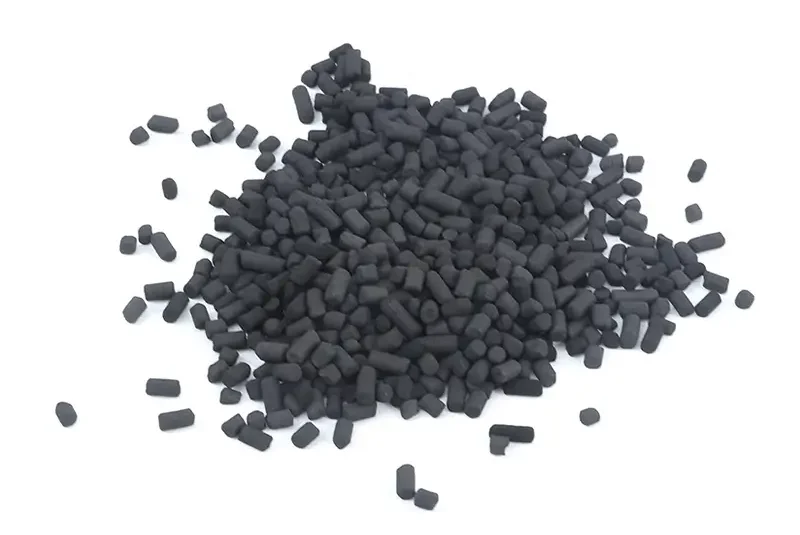
Industrial air purification, gas-phase filtration, and solvent recovery systems demand adsorbent materials that combine high mechanical strength with exceptional adsorption performance. Among the various forms of activated carbon available in the market, extruded activated carbon (EAC), also referred to as pelletized or columnar activated carbon, has emerged as a preferred choice for engineered fixed-bed systems. Its uniform cylindrical geometry and robust physical properties make it uniquely suited for continuous-flow applications where pressure drop, dust generation, and bed stability are critical operational concerns.
Extruded activated carbon is a cylindrical, high-strength porous adsorbent manufactured by grinding carbon-rich raw materials into fine powder, mixing them with a binder, extruding the mixture into uniform pellets under high pressure, and then subjecting the shaped material to carbonization and activation processes. The resulting product features a well-developed pore network with a specific surface area typically ranging from 850 to 1250 m²/g, delivering outstanding physical and chemical adsorption capacity for a wide range of gaseous and liquid-phase contaminants.
Understanding extruded activated carbon requires an examination of its manufacturing process, the key performance parameters that define its quality, and the diverse industrial applications it supports. This article provides a comprehensive technical overview of EAC technology, compares it with other activated carbon forms, and explores the factors that make it the material of choice for demanding purification systems. Whether you are an engineer specifying carbon media for a new installation, a procurement professional evaluating supplier options, or a facility manager optimizing existing treatment processes, this guide offers the detailed information needed to make informed decisions.
1. What Is Extruded Activated Carbon?
Extruded activated carbon is a form of activated carbon produced through an extrusion process that shapes carbonaceous powder blended with binding agents into uniform cylindrical pellets. These pellets typically range from 1.5 mm to 8 mm in diameter and exhibit high mechanical hardness, low dust content, and a well-developed internal pore structure suitable for both gas-phase and liquid-phase adsorption applications.
Extruded activated carbon belongs to the broader family of activated carbon materials, which are characterized by their extremely high surface area per unit mass and their ability to adsorb a wide range of organic and inorganic compounds. The defining feature of EAC is its manufacturing route: unlike granular activated carbon (GAC), which is produced by crushing and sieving larger carbonized materials, or powdered activated carbon (PAC), which is ground into fine dust, extruded carbon is deliberately shaped into cylindrical pellets before the activation step. This shaping process imparts critical physical advantages.
The raw material base for extruded activated carbon is diverse and includes anthracite coal, bituminous coal, coconut shell, wood, and peat. Coal-based raw materials are particularly favored for industrial-grade EAC due to their high carbon content, excellent mechanical strength after processing, and the ability to blend different coal types to achieve specific performance characteristics. Coconut shell-based EAC offers higher microporosity and is often specified for applications requiring superior adsorption of small-molecule contaminants.
2. How Is Extruded Activated Carbon Manufactured?
The manufacturing of extruded activated carbon follows a multi-stage process that includes raw material selection and grinding, binder mixing, high-pressure extrusion into cylindrical pellets, controlled carbonization at 600 to 800 degrees Celsius in an oxygen-free environment, and activation using steam at 800 to 1000 degrees Celsius to develop the final pore structure and surface area.
The production process begins with careful raw material selection. For coal-based EAC, manufacturers often employ coal blending technology, which allows precise adjustment of the final product’s adsorption parameters. Different coal types contribute different properties: anthracite provides high carbon content and structural integrity, while bituminous coal contributes to pore development during activation. The selected raw materials are crushed and ground into a fine powder with a controlled particle size distribution.
In the mixing stage, the powdered carbon precursor is combined with a binding agent such as coal tar pitch or petroleum pitch. The binder serves two essential functions: it provides the plasticity required for the extrusion process, and it contributes additional carbon content that enhances the mechanical strength of the final product after carbonization. The proportion of binder, typically ranging from 15 to 30 percent by weight, must be carefully controlled because excessive binder can block pores while insufficient binder results in weak pellets that generate dust during service.
Extrusion is the defining step of the EAC manufacturing process. The homogenized paste is forced through dies under high pressure, producing continuous strands that are cut into pellets of specified lengths. Common diameters include 1.5 mm, 2 mm, 3 mm, 4 mm, 5 mm, and 8 mm. The length of each pellet is typically 1 to 3 times its diameter. This step gives EAC its characteristic cylindrical shape and ensures consistent particle geometry across the production batch.
During carbonization, the shaped pellets are heated in a rotary kiln at 600 to 800 degrees Celsius under an oxygen-free atmosphere. Volatile organic compounds are driven off, leaving behind a carbon-rich skeleton with initial porosity. The activation stage follows, where superheated steam at 800 to 1000 degrees Celsius reacts with the carbonized pellets via the water-gas reaction, selectively eroding carbon atoms to create a vast network of micropores, mesopores, and macropores. The activation duration and temperature precisely control the target surface area of 850 to 1250 m²/g.
3. What Are the Key Properties and Performance Parameters?
The key performance parameters of extruded activated carbon include iodine value (800 to 1200 mg/g), CTC adsorption (60 to 80 percent), specific surface area (850 to 1250 m²/g), mechanical hardness (95 percent or higher), moisture content (5 percent maximum), and ash content (5 to 10 percent for coal-based grades). These parameters collectively determine the carbon’s suitability for specific applications and its expected service life in industrial systems.
The iodine value is one of the most widely referenced quality indicators for activated carbon. It measures the amount of iodine adsorbed by one gram of carbon and serves as a proxy for microporosity. Higher iodine values indicate greater adsorption capacity for small-molecule contaminants. Carbon tetrachloride (CTC) adsorption is another important parameter that specifically indicates gas-phase adsorption performance, with standard EAC grades achieving 60 to 80 percent CTC activity.
The specific surface area, measured by nitrogen adsorption using the BET method, quantifies the total internal surface available for adsorption. The pore size distribution is equally important: micropores (smaller than 2 nanometers) provide the majority of the surface area, mesopores (2 to 50 nanometers) facilitate adsorbate transport, and macropores (larger than 50 nanometers) serve as transport arteries minimizing diffusion limitations.
| Parameter | Typical Range | Significance |
|---|
| Iodine Value | 800 to 1200 mg/g | Indicator of micropore adsorption capacity |
| CTC Adsorption | 60% to 80% | Gas-phase adsorption performance indicator |
| Specific Surface Area (BET) | 850 to 1250 m²/g | Total available surface area for adsorption |
| Mechanical Hardness | 95% minimum | Resistance to abrasion and dust generation |
| Moisture Content | 5% maximum | Affects net adsorption capacity by weight |
| Ash Content | 5% to 10% (coal-based) | Inert material content; lower values indicate higher purity |
| Bulk Density | 400 to 600 g/L | Influences bed weight and vessel sizing |
| Pellet Diameter | 1.5 mm to 8 mm | Determines bed pressure drop and flow dynamics |
Mechanical hardness is particularly important for EAC because it directly affects operational longevity. EAC pellets must withstand the weight of the carbon column, abrasive forces of gas or liquid flow, and thermal stresses of regeneration cycles without fracturing. A hardness rating of 95 percent or higher is standard for industrial-grade EAC, ensuring low dust generation and minimal pressure drop increase over time.
4. What Are the Primary Applications of Extruded Activated Carbon?
Extruded activated carbon is primarily used in gas-phase purification applications including VOC removal from industrial exhaust, solvent recovery systems, hydrogen sulfide and odor control in biogas and natural gas processing, pressure swing adsorption (PSA) for nitrogen generation, indoor air quality systems, and as a catalyst support in chemical processing. Specialized impregnated grades also address water treatment needs.
Gas-phase purification represents the largest application segment. In industrial manufacturing facilities, EAC-filled adsorption beds capture volatile organic compounds (VOCs) such as benzene, toluene, xylene, and acetone from process exhaust streams. The uniform pellet geometry ensures even gas distribution through the bed, minimizing channeling and maximizing contact between the contaminated air stream and the carbon surface. Solvent recovery is particularly valuable in printing, coating, and pharmaceutical manufacturing, where captured solvents can be desorbed through steam regeneration and recovered for reuse.
In the energy sector, extruded activated carbon plays a critical role in biogas and natural gas purification. Raw biogas from anaerobic digestion contains hydrogen sulfide, siloxanes, and volatile organic silicon compounds that must be removed before the gas can be used in engines or upgraded to biomethane. EAC, often impregnated for enhanced H₂S removal, provides the high mechanical strength and low pressure drop required for continuous gas processing.
| Application Category | Specific Uses | Key Requirements |
|---|
| Industrial Air Purification | VOC removal, odor control, exhaust treatment | High adsorption capacity, low pressure drop |
| Solvent Recovery | Benzene, toluene, xylene, acetone recovery | High CTC value, thermal regeneration stability |
| Biogas and Natural Gas | H₂S removal, siloxane removal, mercury removal | Impregnation capability, high mechanical strength |
| PSA Gas Separation | Nitrogen generation, hydrogen purification | Uniform pore structure, pressure cycle durability |
| Indoor Air Quality | HVAC filtration, air scrubbers, commercial odor control | Low dust content, consistent pellet size |
| Catalyst Support | Chemical processing, petrochemical refining | High surface area, chemical inertness |
| Water Treatment | Chloramine removal, dissolved gas removal | Specialized impregnation, wet strength |
Pressure swing adsorption (PSA) systems for nitrogen generation represent another important application. In PSA nitrogen generators, compressed air passes through a carbon molecular sieve bed where oxygen is preferentially adsorbed. Extruded carbon with precisely controlled pore structures serves as the selective adsorbent, and its mechanical durability is essential for withstanding repeated pressure cycling.
5. How Does Extruded Activated Carbon Compare to Other Forms?
Extruded activated carbon offers higher mechanical strength, lower pressure drop in fixed beds, and more uniform flow distribution compared to granular activated carbon (GAC), while providing significantly lower dust generation and easier handling than powdered activated carbon (PAC). However, GAC generally provides faster adsorption kinetics in liquid-phase applications due to its wider particle size distribution and larger external surface area per unit mass.
The activated carbon market offers three primary physical forms, each with distinct characteristics. Granular activated carbon is produced by crushing and sieving carbonized material into irregular granules with a mix of coarse and fine particles. This irregular shape has advantages in liquid-phase applications where varied particle sizes create a more tortuous flow path. However, in gas-phase fixed-bed systems, the irregular shape can lead to higher pressure drop and increased channeling.
Powdered activated carbon consists of fine particles predominantly smaller than 0.18 mm. PAC offers the fastest adsorption kinetics due to its extremely high external surface area and short diffusion path lengths, but it cannot be used in fixed-bed systems and is not regenerable in most applications, making it a single-use consumable.
| Parameter | Extruded (EAC) | Granular (GAC) | Powdered (PAC) |
|---|
| Shape | Cylindrical pellets | Irregular granules | Fine dust |
| Typical Size | 1.5 to 8 mm diameter | 0.4 to 4.75 mm | Less than 0.18 mm |
| Mechanical Strength | Very high (95%+ hardness) | Moderate to high | Not applicable |
| Pressure Drop | Low | Moderate to high | Not used in fixed beds |
| Dust Generation | Very low | Low to moderate | High |
| Regenerability | Excellent (85%+ recovery) | Good to excellent | Limited |
| Primary Phase | Gas phase | Liquid phase | Liquid phase (batch) |
| Flow Distribution | Uniform | Variable | Not applicable |
The superior mechanical strength of extruded activated carbon translates directly into longer service life. During thermal regeneration at 800 degrees Celsius or higher, EAC maintains structural integrity better than GAC, with documented recovery rates of 85 percent or higher across multiple regeneration cycles. This regenerability reduces the frequency of complete media replacement and minimizes waste disposal costs.
6. What Are the Advantages of Using Extruded Activated Carbon?
The primary advantages of extruded activated carbon include uniform pellet geometry that ensures stable bed flow and minimal channeling, high mechanical strength with hardness ratings exceeding 95 percent, low pressure drop across the adsorption bed, very low dust generation that prevents system blockages, excellent regenerability with recovery rates above 85 percent, chemical inertness under normal operating conditions, and the ability to customize pellet diameter and formulation to meet specific process requirements.
Uniform pellet geometry is the most significant advantage of EAC over other activated carbon forms. In fixed-bed adsorption systems, uneven gas or liquid distribution can create preferential flow channels where the adsorbate bypasses much of the available carbon surface, dramatically reducing effective adsorption capacity. The consistent cylindrical shape and narrow diameter tolerance of EAC pellets produce a bed with predictable void fraction and flow resistance.
Low pressure drop is a critical economic consideration for continuously operating gas-phase systems. Every pascal of pressure lost across the carbon bed represents additional energy consumption. EAC’s smooth cylindrical surface and uniform packing arrangement minimize flow resistance compared to irregularly shaped granules. For large industrial installations processing thousands of cubic meters per hour, even a modest reduction in pressure drop can translate into significant annual energy savings.
Customization capability extends the advantages of EAC. The extrusion process allows manufacturers to produce pellets in various diameters. Smaller diameters (1.5 to 2 mm) provide higher external surface area and faster adsorption kinetics. Larger diameters (4 to 8 mm) offer lower pressure drop for high-flow applications. Beyond diameter selection, manufacturers can also impregnate the carbon with chemical agents during or after production to enhance removal of specific contaminants such as hydrogen sulfide, sulfur dioxide, ammonia, and mercury.
The economic advantages of EAC extend beyond its initial purchase price. The material’s long service life, enabled by its mechanical durability and regenerability, reduces the total cost of ownership. Fewer bed replacements mean less production downtime, lower labor costs for media changeouts, and reduced disposal expenses. According to market analysis, the global extruded activated carbon market continues to grow, with water treatment applications projected to register the fastest CAGR of 10.9 percent through 2034, driven by rising industrial wastewater generation and stricter discharge regulations.
Summary
Extruded activated carbon stands as a technologically advanced adsorbent material that addresses the demanding requirements of modern industrial purification systems. Its manufacturing process yields a product with precisely engineered geometry and consistent performance characteristics. The resulting cylindrical pellets deliver high mechanical strength, uniform bed packing, low pressure drop, and minimal dust generation, making EAC the preferred choice for fixed-bed gas-phase applications ranging from VOC abatement and solvent recovery to biogas purification and PSA gas separation.
The quantitative performance parameters of extruded activated carbon, including iodine values of 800 to 1200 mg/g, CTC adsorption of 60 to 80 percent, and BET surface areas of 850 to 1250 m²/g, place it among the highest-capacity adsorbents available for industrial use. Its chemical inertness, thermal stability, and regenerability ensure reliable long-term operation with predictable maintenance requirements and manageable operating costs. For engineers and facility managers evaluating carbon media for new installations or optimizing existing systems, extruded activated carbon offers a compelling combination of adsorption performance, mechanical durability, and economic efficiency that few alternative materials can match.