
Across sugar refineries, pharmaceutical plants, juice bottling lines, and chemical works, color is one of the first quality signals a customer notices. A dark molasses stream, an amber fermentation broth, or a brown plant extract usually has to become a clear, water-white liquid before it can be sold. Membrane filtration, ion exchange, and oxidizing bleaches all play a role in industry, but activated carbon decolorization remains the most widely used technique for stripping unwanted color from liquids without disturbing the chemistry of the product itself.
Decolorization activated carbon works by adsorbing large, color-causing organic molecules onto an enormous internal pore network. Physical forces such as van der Waals attraction and π–π stacking, reinforced by electrostatic interactions and hydrogen bonding, lock chromophores onto the carbon surface, while a well-developed mesopore structure allows these relatively large pigment molecules to enter in the first place. Raw material, activation method, particle size, and operating parameters such as dosage, pH, temperature, and contact time determine how efficiently that happens.
The sections below unpack the science step by step: what decolorizing carbon is, how the adsorption mechanisms work, how the material is made, which specifications matter most, and how to select and operate the right grade for an industrial process.
What Is Decolorization Activated Carbon?
Decolorization activated carbon is a form of activated carbon engineered to adsorb large, color-causing organic molecules from liquids, rather than the small dissolved contaminants targeted by ordinary carbon grades. Its defining feature is a pore network rich in mesopores, which are wide enough to admit pigment molecules that micropore-dominant carbons would exclude.
Like all activated carbons, decolorizing grades are made from carbon-rich raw materials that are carbonized and then activated to create an internal surface area that can exceed 1,000 square meters per gram. What separates a decolorizing grade from a general-purpose grade is the distribution of that surface area across pore sizes. Standard carbons for water purification tend to be micropore-dominant because contaminants such as chlorine, chlorinated solvents, and volatile organic compounds are small molecules. Color bodies are different: they are bulky, aromatic, and often partially polymerized, so they need transport pores as well as adsorption sites.
Decolorization activated carbon is supplied in both powdered activated carbon and granular forms. Powdered grades, typically ground below 200 mesh, are dosed directly into a liquid, mixed, and then filtered out, which is the standard approach for batch decolorization in sugar, food, and pharmaceutical plants. Granular grades are loaded into fixed beds or columns for continuous operation, which is common in large refineries and water treatment facilities.
What Makes Color-Causing Molecules Different?
Color in liquids almost always comes from organic molecules that contain chromophores, which are arrangements of conjugated double bonds and aromatic rings that absorb visible light. Typical offenders include:
- Melanoidins, brown polymeric compounds formed in Maillard reactions during sugar processing and fermentation
- Caramelization products, high-molecular-weight polymers created when sugars are overheated
- Polyphenols and tannins from plant-derived raw materials such as fruit juices, wines, and botanical extracts
- Humic and fulvic acids that give natural water its yellow-brown tint
- Synthetic dyes from textile and dye manufacturing, which are designed specifically to resist fading
Most of these molecules fall roughly between 200 and several thousand daltons in molecular weight, far larger than the small molecules that dominate microporous adsorption. Many are planar and electron-rich, a geometry that turns out to be highly favorable for adsorption onto carbon surfaces. This combination of large size and aromatic structure is exactly what the mesopore network of a decolorizing carbon is built to capture.
How Does Activated Carbon Remove Color? The Science of Adsorption
Activated carbon removes color through adsorption, the adhesion of dissolved pigment molecules onto the carbon’s internal surface. Several forces act together: weak but pervasive van der Waals attraction, strong directional π–π stacking between aromatic rings and the carbon’s graphene-like planes, and, depending on surface chemistry and pH, electrostatic attraction and hydrogen bonding. Adsorption is a surface phenomenon rather than absorption: the color molecules are captured on the pore walls, not soaked into a bulk material.
Physisorption: Van der Waals Forces and π–π Stacking
The dominant driver is physical adsorption, or physisorption. Every activated carbon contains tangled stacks of graphene-like sheets, and the delocalized electrons in those aromatic planes interact strongly with the aromatic rings and conjugated double bonds that make up chromophores. This interaction, known as π–π stacking, explains why activated carbon is so selective toward dyes and natural pigments, most of which are aromatic, over small polar molecules such as sugars and salts. Peer-reviewed studies of dye adsorption consistently identify π–π interactions as the leading mechanism, assisted by dispersion and hydrogen-bonding contributions.
Physisorption is fast, with powdered carbon often reaching adsorption equilibrium within minutes, and it is reversible, which matters later when regeneration or reuse is considered.
Electrostatic Interactions, Hydrogen Bonding, and Surface Chemistry
Carbon surfaces are not chemically inert. Oxidation during activation and manufacturing leaves oxygen-containing functional groups, including carboxyl, hydroxyl, phenolic, and lactone groups, that change how the surface behaves in water. These groups carry charge that depends on the solution pH, so the electrostatic relationship between the carbon surface and an ionized pigment can be tuned:
- At pH values below the carbon’s point of zero charge, the surface is net positive and attracts anionic, or acid, dyes.
- Above that point, the surface is net negative and favors cationic, or basic, dyes.
- Hydrogen bonding between surface groups and pigment functional groups adds a further layer of selectivity.
Where a pigment reacts chemically with surface groups, forming stronger and partly irreversible bonds, the process shades into chemisorption and surface complexation. This is a minor but useful contributor to decolorization, particularly for metal-complex dyes and pigments carrying ionizable side groups.
Why Mesopores Decide Decolorization Performance
Pores are classified by diameter, and each class plays a distinct role in color removal:
| Pore Class | Diameter | Primary Role in Decolorization |
| Micropores | Below 2 nm | High-energy adsorption sites for small molecules; measured by iodine value |
| Mesopores | 2 to 50 nm | Transport pathways and adsorption sites for large color bodies; measured by methylene blue value |
| Macropores | Above 50 nm | Entry channels that speed diffusion deep into the particle |
A color molecule several nanometers across simply cannot enter a micropore, no matter how attractive the adsorption site behind it. Mesopores are therefore the decisive architecture, because they give pigment molecules physical access to a large share of the carbon’s internal surface. This is why wood-based decolorizing grades, whose raw material naturally develops a wide-pore network, consistently outperform micropore-dominant grades on methylene blue and caramel color tests even when their iodine numbers are similar. Pore size distribution, more than total surface area, is what separates an excellent decolorizing carbon from a mediocre one.
How Is Decolorization Activated Carbon Manufactured?
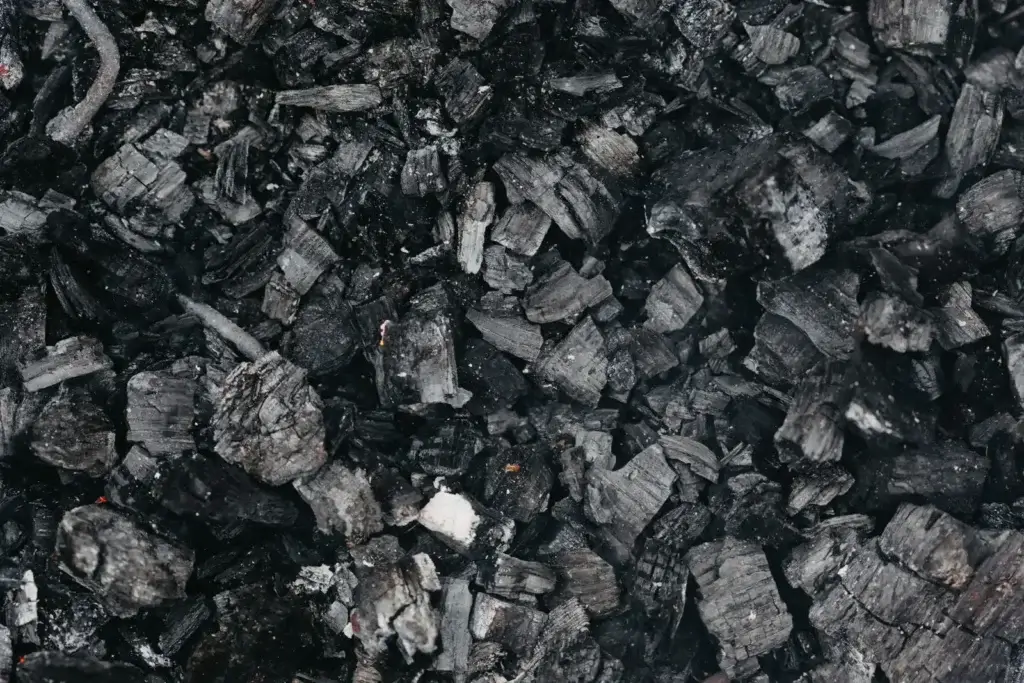
Decolorization activated carbon is produced by carbonizing a raw material and then activating it, either with phosphoric acid at moderate temperatures or with steam at high temperatures, under conditions deliberately chosen to develop mesopores. The raw material sets the upper limit of what the pore structure can become; the activation method determines how close the final product gets to that limit.
Raw Materials: Wood, Coconut Shell, and Coal
| Raw Material | Pore Tendency | Strengths | Considerations | Typical Fit |
| Wood | Mesopore and macropore rich | Highest decolorization capacity, low ash, renewable feedstock | Softer particles that need careful handling | Sugar, food, and pharmaceutical decolorization |
| Coconut shell | Micropore dominant | Very hard, high iodine value, long service life | Natural mesopores limited unless the process is adjusted | Mixed purification and water treatment |
| Coal | Mixed and denser | Cost effective, high mechanical strength | Higher ash content, often requiring acid washing | Industrial and wastewater decolorization |
Wood is the classic choice for decolorization because its botanical structure converts into a wide-pore network that suits large pigments. Coconut shell activated carbon is prized for hardness and microporosity, and it can be processed to open secondary mesoporosity when a process needs color removal and small-molecule polishing in a single bed. Coal based activated carbon offers a cost-effective middle ground for heavy industrial duties, though ash reduction through acid washing is usually required for food-adjacent applications.
Activation Methods: Phosphoric Acid vs Steam Activation
Chemical activation with phosphoric acid is the industry standard for wood-based decolorizing carbons. Impregnating the raw material with phosphoric acid before a moderate-temperature activation step, typically around 400 to 500 degrees Celsius, promotes dehydration and pore widening, which preserves the raw structure and opens an exceptionally well-connected mesopore network. Phosphoric acid activated carbon typically shows low ash content, an acidic to near-neutral pH, and high methylene blue adsorption, which is precisely the profile that food and pharmaceutical decolorization demands. Steam activation, by contrast, runs at roughly 900 to 1,000 degrees Celsius and burns channels into the particle, producing harder, micropore-dominant carbons that excel at gas-phase and small-molecule work but need careful process control to reach strong decolorization values.
Key Specifications for Evaluating Decolorization Activated Carbon
Buyers should judge a decolorizing carbon by its methylene blue number first, its iodine value second, and then by particle size, ash, pH, and moisture. The methylene blue number reflects mesopore capacity and therefore predicts decolorization performance; the iodine value reflects micropore capacity and predicts general adsorption.
These properties are measured with standardized test methods maintained by bodies such as ASTM International’s D28 Committee on Activated Carbon, which allows buyers to compare products from different suppliers on equal terms.
| Specification | What It Measures | Typical Target for Decolorizing Grades |
| Methylene blue number | Mesopore volume and capacity for large molecules | Roughly 8 to 14 mL per 0.1 g, equivalent to 150 to 250 mg/g |
| Iodine number | Micropore volume and small-molecule capacity | At least 1,000 mg/g |
| Caramel decolorization | Performance against sugar-pigment analogues | At or above the reference value |
| Particle size | Kinetics versus filterability trade-off | Powdered grades near 200 mesh; finer means faster but harder to filter |
| Ash content | Soluble impurities affecting product purity | 3 to 5 percent or lower; acid-washed grades lower still |
| pH of water extract | Surface acidity or alkalinity | Typically 4.5 to 7.5 |
| Moisture | Dosage accuracy and packaging stability | 10 percent or less |
A practical caution: the methylene blue number is the single best purchasing proxy for decolorization performance, but it is not the whole story. Two carbons with equal methylene blue values can still differ in caramel decolorization, filtration behavior, and soluble impurities. Whenever possible, confirm performance with laboratory jar tests on your own liquor before committing to a full-scale order.
Process Parameters That Control Decolorization Results
Decolorization performance in the plant is controlled by five operating levers: carbon dosage, contact time, temperature, pH, and mixing. Each has a typical industrial window, and pushing any of them far outside that window wastes carbon, slows filtration, or degrades the product.
- Dosage. Powdered carbon is normally dosed at 0.1 to 2 percent of the weight of the liquor, with many food and pharmaceutical processes running near the lower half of that range. More is not automatically better: excess carbon raises cost, increases filtration load, and can begin adsorbing desirable compounds such as active ingredients or flavor molecules.
- Contact time. Fifteen to thirty minutes of well-mixed contact is a common industrial window for powdered carbon. Adsorption is fast at first and then approaches equilibrium, so extending contact far beyond the equilibrium point adds cost without adding color removal.
- Temperature. Moderate warmth, around 50 to 60 degrees Celsius, lowers liquor viscosity and speeds diffusion into the pores. Above roughly 80 degrees, adsorption weakens, because adsorption releases heat and high temperature pushes the equilibrium backward, and carbon oxidation becomes a concern.
- pH. Slightly acidic conditions, typically pH 4 to 6, give the best results for most natural pigments because they keep surface charge and pigment ionization in a favorable balance. Adjusting pH is often the cheapest performance upgrade available.
- Mixing and separation. Gentle, uniform agitation keeps particles suspended without shearing them; overly vigorous agitation generates fines that blind filters. After contact, the carbon is removed by filtration, often with a filter aid, followed by polishing filtration to guarantee a sparkling clear liquor.
The correct combination is established with a simple laboratory jar test series: a dose-response run at fixed time and temperature, followed by a time-response run at the chosen dose. Scaling those results with a modest safety margin gives a dependable plant recipe.
Industrial Applications of Decolorization Activated Carbon
Decolorization activated carbon is used wherever a liquid product must be visibly clean: sugar refining and starch sweeteners, edible oils and beverages, pharmaceutical intermediates and fermentation products, and the treatment of colored industrial effluents. The pigment chemistry differs by industry, but the adsorption principles are identical.
Sugar Refining and Starch-Based Sweeteners
Raw cane and beet syrups carry melanoidins, caramels, and polyphenols that must be stripped to produce white sugar and water-clear syrups. Large refineries often run granular carbon beds that are regenerated continuously in on-site kilns, while batch plants dose powdered carbon into the melt liquor. High-fructose corn syrup and glucose syrups are polished the same way to meet the water-clear standards of the beverage industry.
Food and Beverage Processing
In edible oil refining, carbon complements bleaching earth by adsorbing color bodies and oxidation byproducts that clays handle poorly. Fruit juices and concentrates are treated to remove enzymatic and non-enzymatic browning products, which extends shelf life and stabilizes appearance. In distilleries, carbon polishing removes tannins, fusel oils, and color carryover from spirits such as vodka and rum. Dosed correctly, the treatment removes color without measurable loss of the sugars, acids, and aromas that define the product.
Pharmaceutical and Fine Chemical Production
Active pharmaceutical ingredients and their intermediates must meet strict color-limit specifications, and powdered carbon decolorization is the standard purification step for fermentation-derived products such as citric acid and lactic acid. Dye intermediates and specialty chemicals are treated similarly. Pharmaceutical grades carry extra purity requirements, including low ash, low iron, and controlled heavy metals, because anything the carbon releases will end up in the product.
Industrial Wastewater and Municipal Water Color Removal
Textile and dye-house effluents are a major application: adsorption on carbon removes reactive, acid, and basic dyes that survive biological treatment, helping plants meet the color limits written into discharge permits. Specialized grades of activated carbon for wastewater treatment are engineered for exactly this duty, and the technique is recognized by regulators. The same chemistry applies to potable water: humic and fulvic acids give some groundwater a yellow-brown tint, and activated carbon for drinking water removes that color ahead of disinfection, an application documented in the U.S. EPA’s technical brief on granular activated carbon.
Powdered vs Granular Activated Carbon for Decolorization
Powdered activated carbon suits batch decolorization, meaning dose, mix, and filter, and delivers fast kinetics at low capital cost; granular activated carbon suits continuous fixed-bed operation with on-site regeneration. The right choice depends on flow volume, how often the color load changes, and whether spent carbon can be regenerated economically.
| Attribute | Powdered Carbon | Granular Carbon |
| Particle size | Fine powder, typically 200 mesh or finer | Granules in the 8 by 30 to 12 by 40 mesh range |
| Operating mode | Batch: dose into tank, mix, filter out | Continuous: fixed beds or columns |
| Kinetics | Minutes to equilibrium | Controlled by empty-bed contact time |
| Capital cost | Low, using existing tanks and filters | Higher, requiring columns, pumps, and a regeneration kiln |
| Carbon consumption | Single use unless recovered | Multiple cycles through regeneration |
| Best fit | Food, pharmaceutical, and fine chemical batch work with variable loads | Large refineries and water plants with steady flows |
Batch contact with granular activated carbon is possible in a column or even in an agitated vessel, but granular carbon earns its keep in continuous service, where its hardness and regenerability offset the higher capital cost. Many plants use both: granular beds for base-load polishing and powdered carbon for emergency episodes or seasonal color spikes.
Regeneration and Reuse: Extending Carbon Value
Spent granular carbon can be regenerated thermally and cycled many times; powdered carbon is usually used once and discarded, except in very large systems that recover it. Regeneration economics decide whether decolorization stays affordable at scale.
Thermal regeneration reheats spent granular carbon to 800 to 1,000 degrees Celsius in low-oxygen kilns, volatilizing and decomposing the adsorbed organics. Each cycle costs some carbon mass, typically a few percent, and can slightly coarsen the pore structure, so capacity is monitored cycle by cycle. Sugar refineries regenerate continuously and count on dozens of cycles before replacement. Chemical regeneration, for example with caustic solutions, can recover part of the capacity in place but rarely restores it fully, and it introduces a waste stream of its own.
Spent powdered carbon from food and pharmaceutical plants is normally single use, because purity rules and the risk of cross-contamination make reuse uneconomical at smaller scales. The spent cake is dewatered and disposed of, sometimes incinerated with energy recovery. The honest way to compare options is cost per unit of color removed over a full year, including filtration losses, labor, and disposal, rather than the price per ton of carbon.
How to Select the Right Decolorization Activated Carbon for Your Process
Selecting a decolorizing carbon is a matching exercise: characterize the color problem, match it to a pore architecture and purity grade, choose the operating format, and then verify everything with jar or column trials before scaling up.
- Characterize the color. Identify the pigment family, whether melanoidin, caramel, polyphenol, or synthetic dye, along with its molecular weight, charge, and pH sensitivity. Composition dictates the pore size that will work.
- Match pore architecture. Large aromatic pigments call for high mesoporosity, indicated by a strong methylene blue number, while mixed loads may need a balance of micro- and mesopores.
- Set purity requirements. Food and pharmaceutical applications demand low ash, low iron, and heavy-metal limits; industrial wastewater duties can trade some purity for economy.
- Choose the format. Batch powdered carbon offers flexible, fast, low-capital operation; granular beds suit continuous, high-volume flows with regeneration.
- Validate before committing. Run dose-response and kinetic jar tests, or column trials, on the actual liquor, and fit adsorption isotherms if the color load varies widely.
- Compare total cost, not unit price. Filterability, dosage efficiency, and disposal or regeneration costs routinely outweigh a small difference in carbon price.
A supplier who can document test methods, provide isotherm data, and adjust grading to your liquor is worth more than a slightly lower quotation, because decolorization is a running process rather than a one-time purchase.
Frequently Asked Questions
What is the difference between iodine value and methylene blue value?
The iodine number measures the adsorption of small iodine molecules, so it reflects micropore capacity and the carbon’s ability to capture small contaminants. The methylene blue number measures the adsorption of a comparatively large dye molecule, so it reflects mesopore capacity and tracks decolorization performance. For color removal, the methylene blue number is the figure to compare first, while the iodine number confirms the carbon is also competent at general purification.
Is decolorization activated carbon safe for food and pharmaceutical applications?
Yes, provided the grade is manufactured to the relevant food or pharmacopoeia specifications. Dedicated grades are produced under quality-controlled conditions with tight limits on ash, iron, and heavy metals, and many are acid-washed to reduce soluble impurities further. They are also tested against recognized standard methods so buyers can verify compliance lot by lot. Ordinary industrial grades should never be substituted for certified decolorizing grades in these applications.
Does activated carbon remove color without affecting taste, aroma, or nutrients?
When correctly dosed, decolorizing carbon is highly selective: it targets large, aromatic color molecules and largely leaves sugars, organic acids, minerals, and vitamins untouched. Problems arise from overdosing, excessive contact time, or unnecessarily fine carbon, which can strip aroma compounds or active ingredients along with the color. This is why dose-response testing on the real product, rather than a generic recipe, remains the professional approach.